Page updated March 20, 2025
Page updated
March 20, 2025
Home Page | Louisville Radio | Lexington Radio | Message Board | Contact Us
| 95.7 WQHI | |
| WQHI Sales Kit | WQHI Audio | WQHI Jingles | |
|
Know
anything more about this station? Have any WQHI airchecks, photos or
promotional material? Drop us a line. |
|
 A History of WQHI by Bill Elliott, original Operations Manager/Chief Engineer © 2006 by Bill Elliott WQHI, aka HI-95, hit the
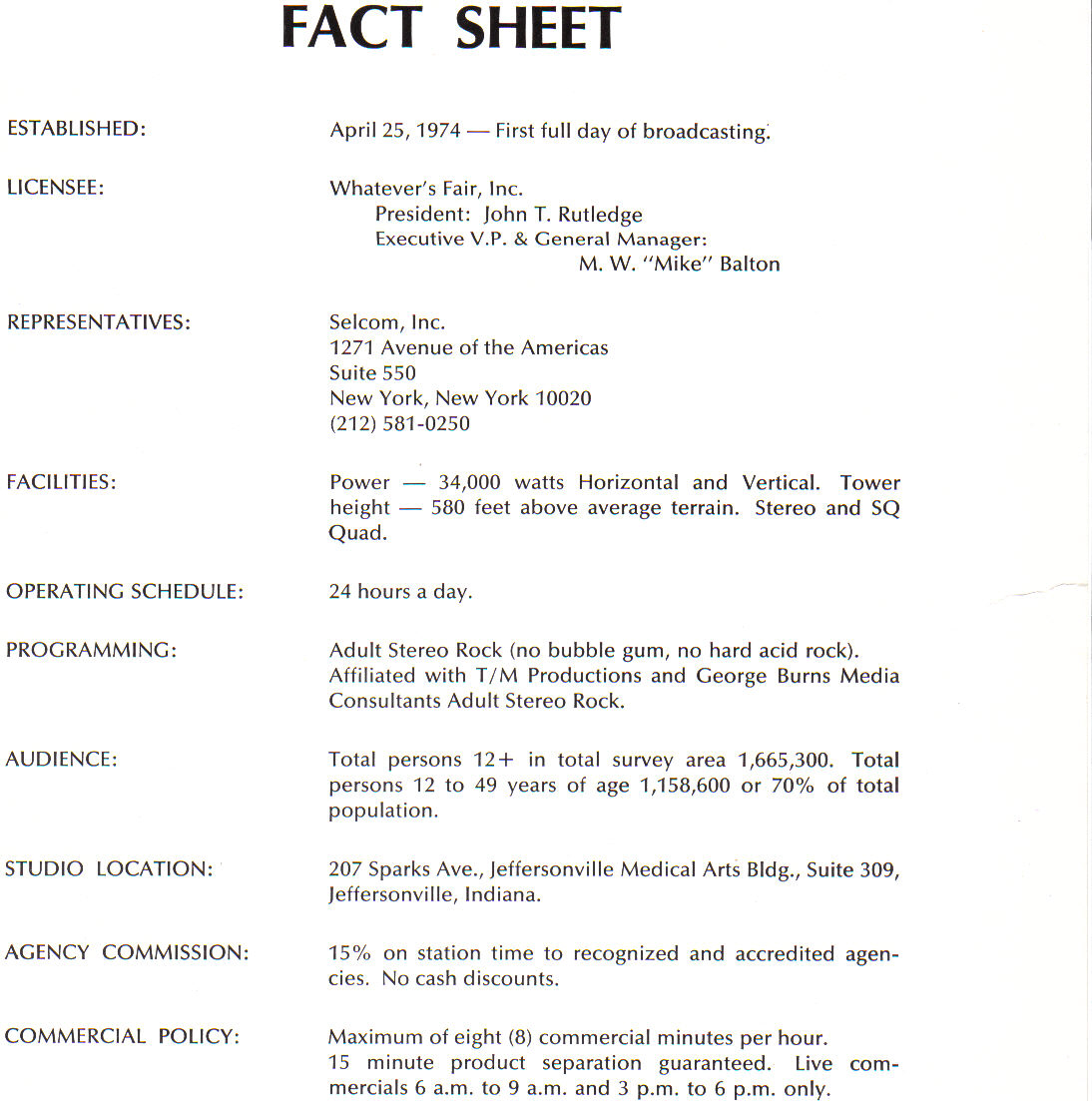
Louisville airwaves in April 1974. Consisting of a 1,400 sq. ft.
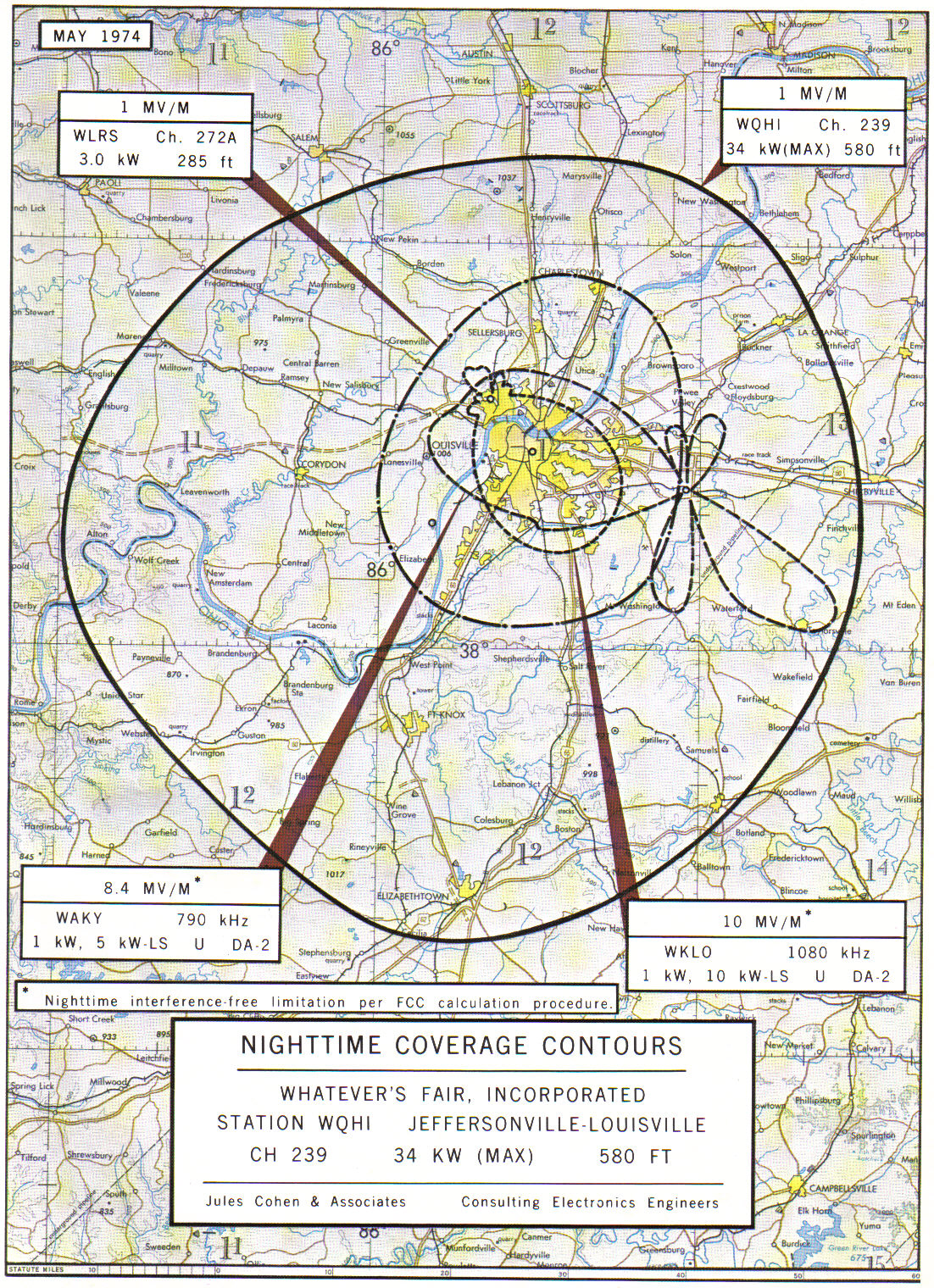
studio/office in Jeffersonville, the transmitter site was in Harrison
County, Indiana.
A quick sidebar to the name, "Whateversfair, Inc." It was inspired by
Rutledge's signature response to new ideas. Run something by him and you
usually were given, "whatever's fair" as a response. Rutledge also had a
couple of other short-lived broadcast companies: "Great Joy, Inc.", which
was his usual positive response when things were going right, and
"Virtually Perfect, Inc.," which was how he responded when asked how he
was doing that day. He loved these lines so much, they became corporate
names.  We were still going with the concept of "Stereo 96" even with TM signed
up. There was one nagging problem that we could not get over. How
redundant does "Stereo Rock on Stereo 96" sound? We were sitting around
the General Manager's house while still in Florida brainstorming the logo
one evening. We had three elements in front of us: "WQHI", which was
picked by the FCC; "95.7", which was the frequency; and "Stereo 96", that
just did not go well with TM's "Stereo Rock," which they promoted heavily
in their identifiers (jingles, custom liners, etc.). Back in 1973, no one
used decimal point frequencies as on-air identifiers. It was easier to
look at your slide rule FM tuner and locate "92", "101" or whatever. The
conversation of the evening started out that the station was at "96," so
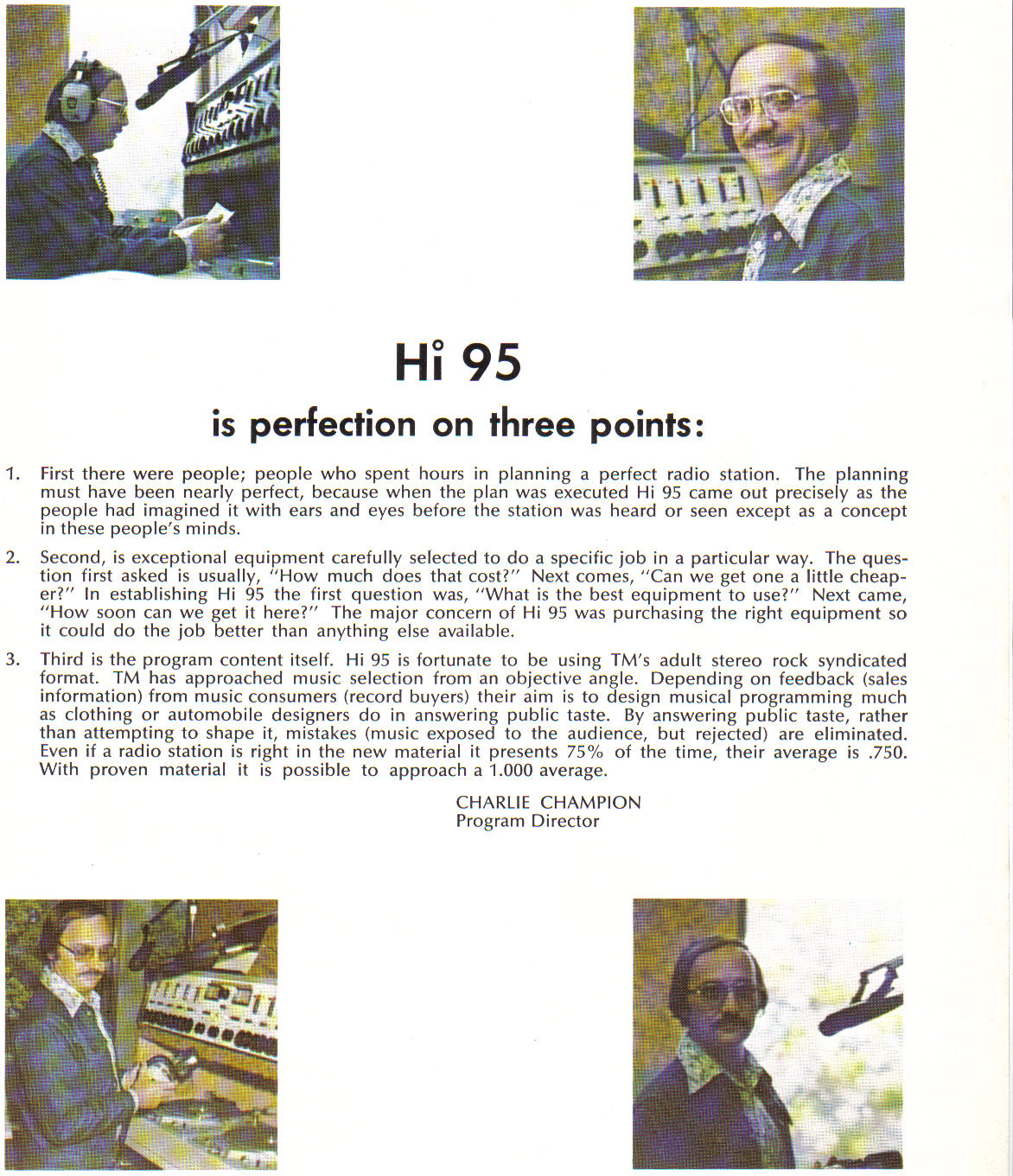
what do we put in front of it? Charlie Champion, our original program
director, all of the sudden blurted out "Hi 95" with the argument that the
"HI" part was already in the call letters and the "95" part was part of
our frequency anyway. So the station became "HI-95" that night in late
1973 due to someone arguing it wasn't "96" on the dial, but since it was
95.7, it was sure enough "HI-95"!
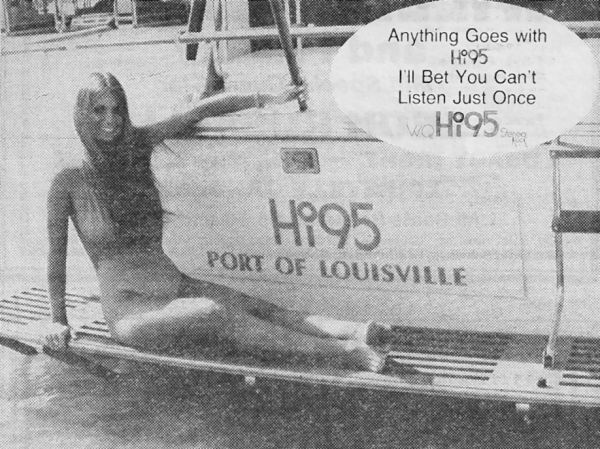
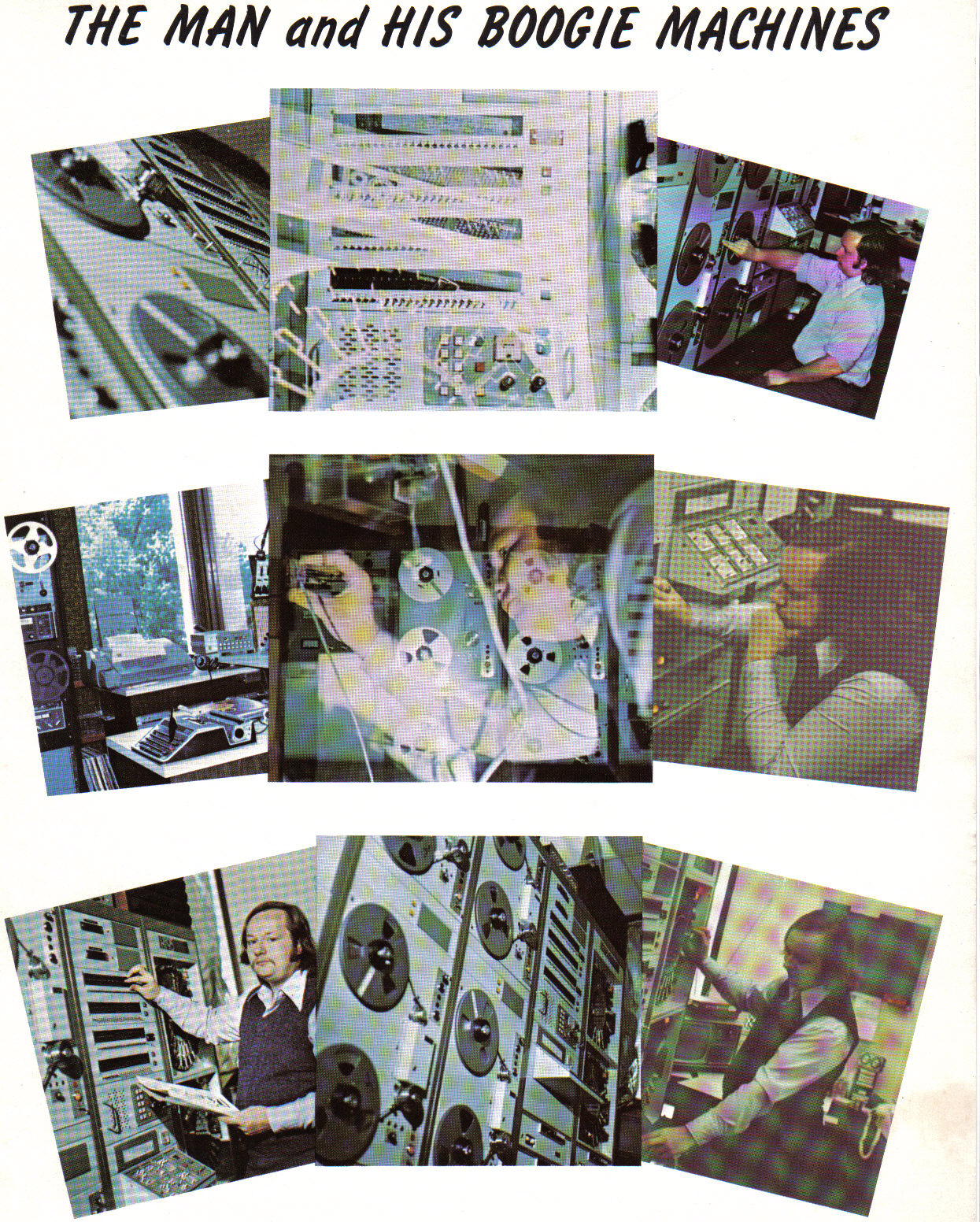
We got the OK from the FCC to sign-on and, as they say, the rest is history. Our first song? "Oh My My," by Ringo Starr. We decided our big hunk of green metal automation machine should have a name. It became the "Boogie Machine," so we thought it appropriate to play Ringo with part of the lyrics being, ".......can you boogie?" 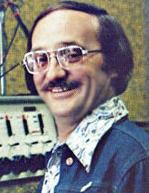 WQHI's Charlie Champion (1974-1975) The studios consisted of one production room that doubled as a control room and one room for the automation. The production room was equipped completely stereo, including the mikes. A list of the equipment is as follows:
All of the studio equipment was mounted on risers for "stand-up" operation. The studio/offices were located on the third floor of the Medical Arts building with the production room being in the corner of the suite. We had two windows on each corner that gave us a nice view from there.
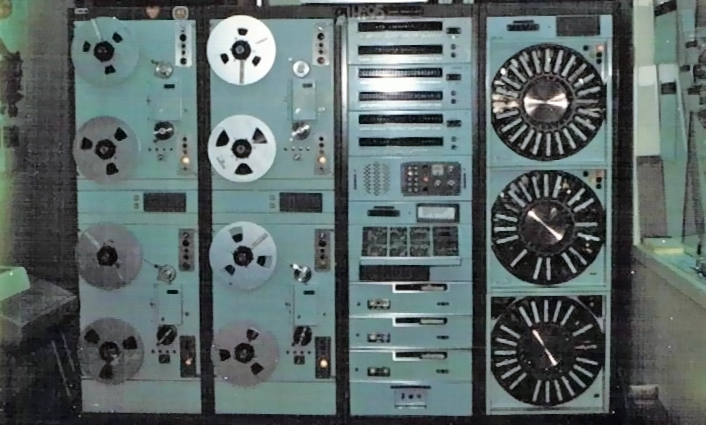
The automation was a SMC (Sono Mag Corp) Model 3060. It was a totally sequential system that had to be programmed by either slide switches (on the main controller) or thumbwheel switches (on the carousel controllers). It was capable of handling 10 stereo sources, which we had full. It came in five racks, which consisted of:
The audio chain was a CBS
Labs Audimax for audio leveling and a CBS Labs Volumax for peak limiting.
We never thought it was necessary to "crank" these things for loudness. We
let that nonsense up to the AMs. We tried to have the best sounding audio
possible while controlling overall levels for FCC compliance. The station
had a good "warm" sounding stereo signal.
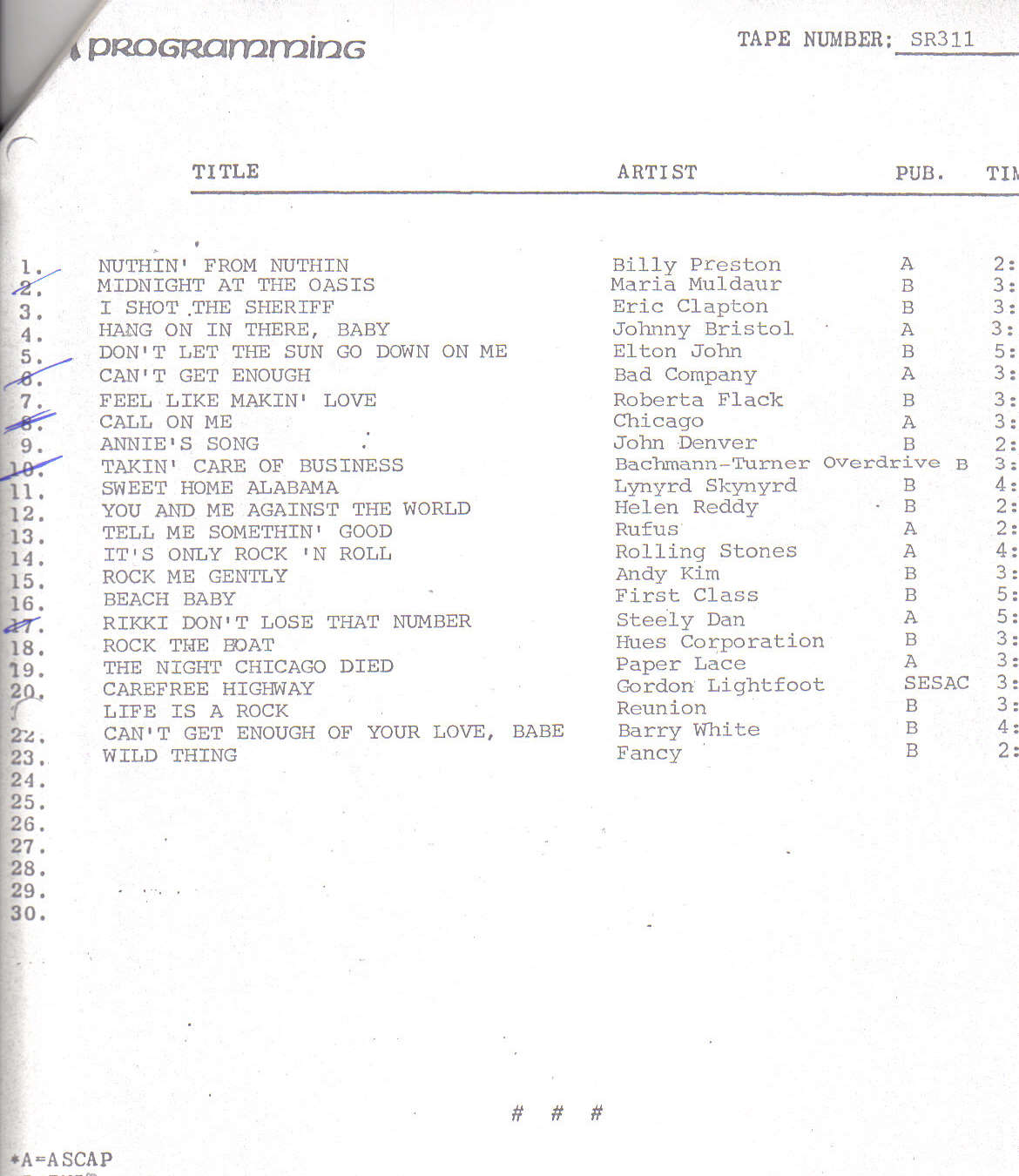
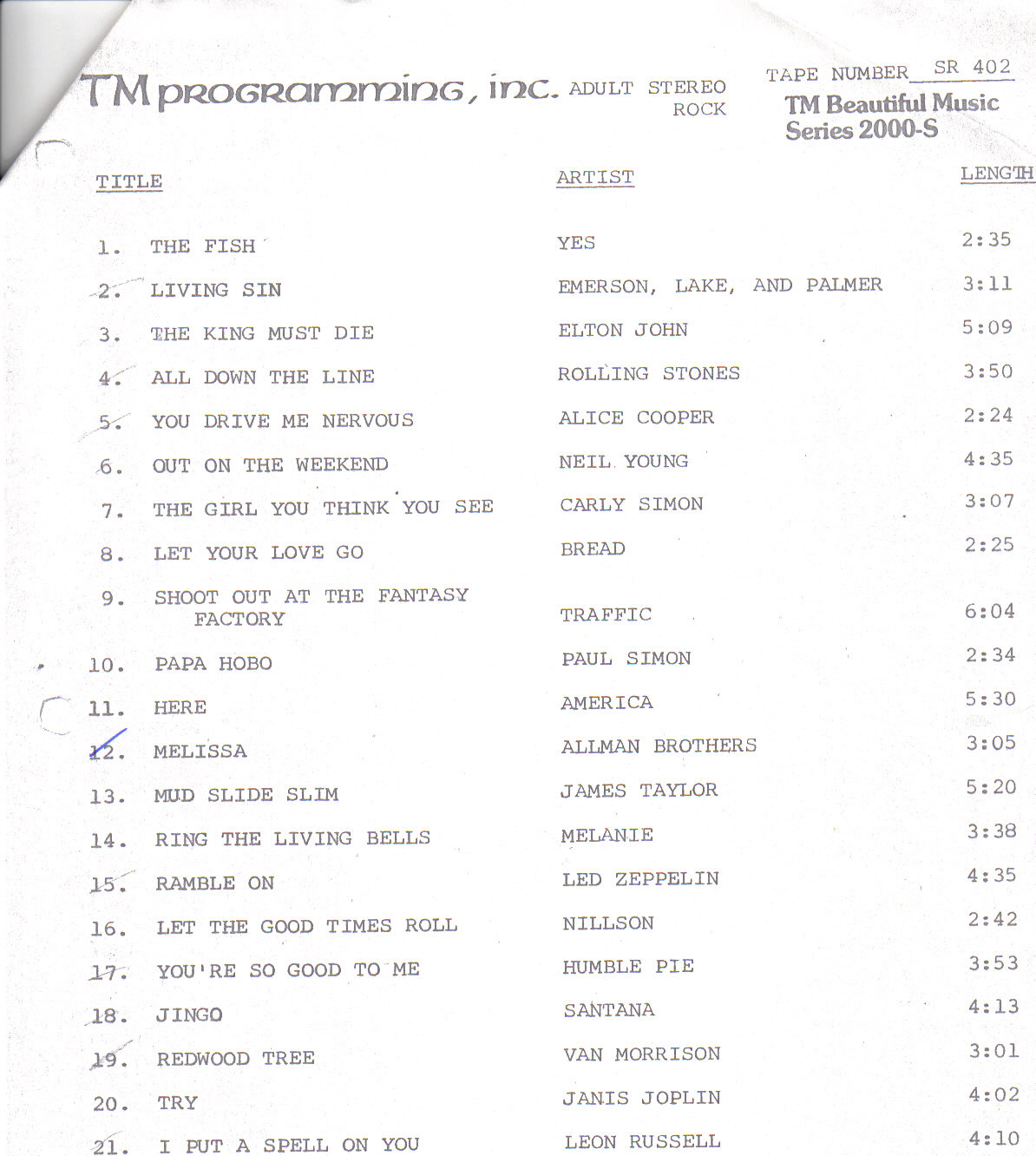
 WQHI License Plate A little about TM's Stereo Rock:
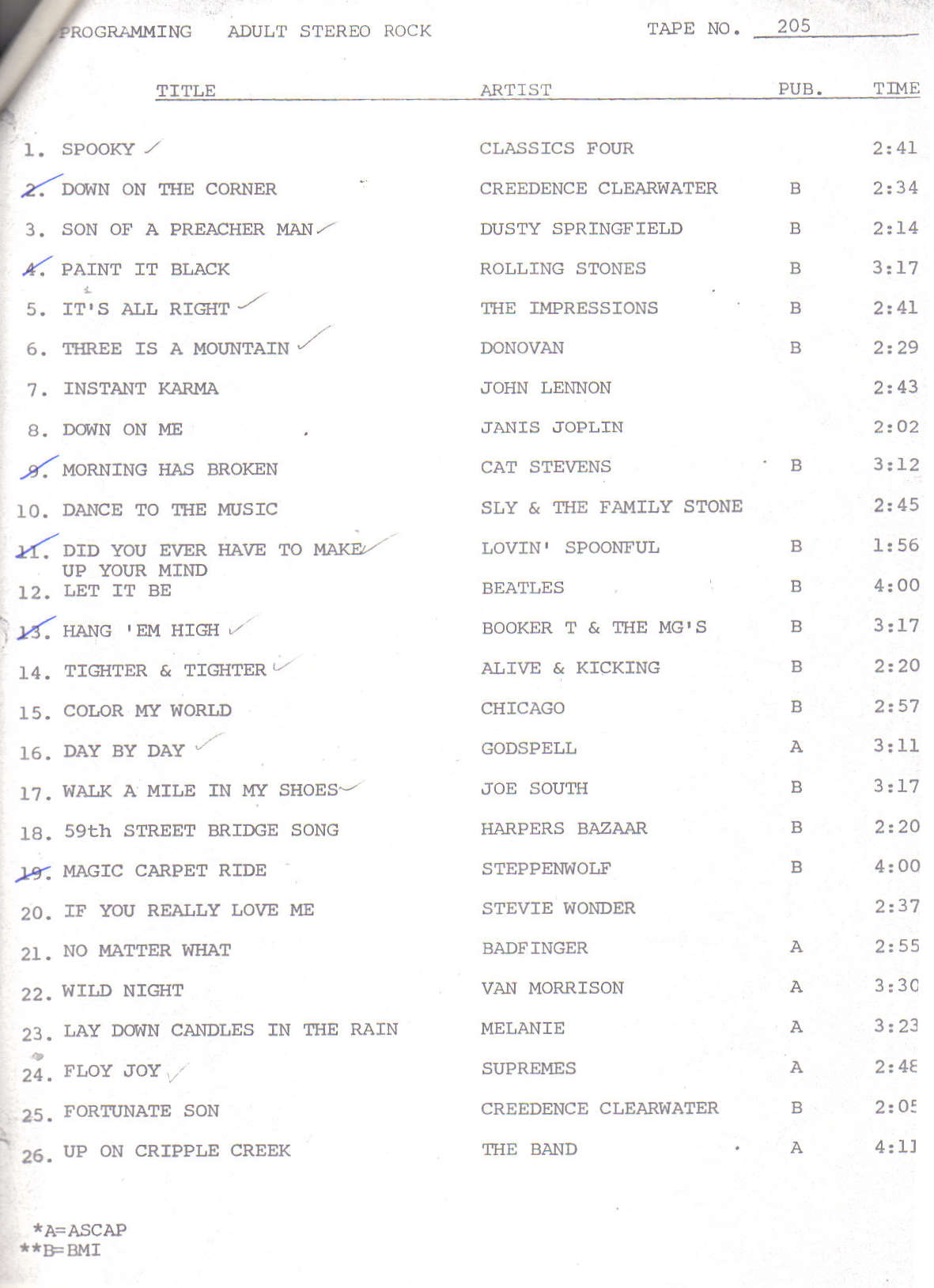
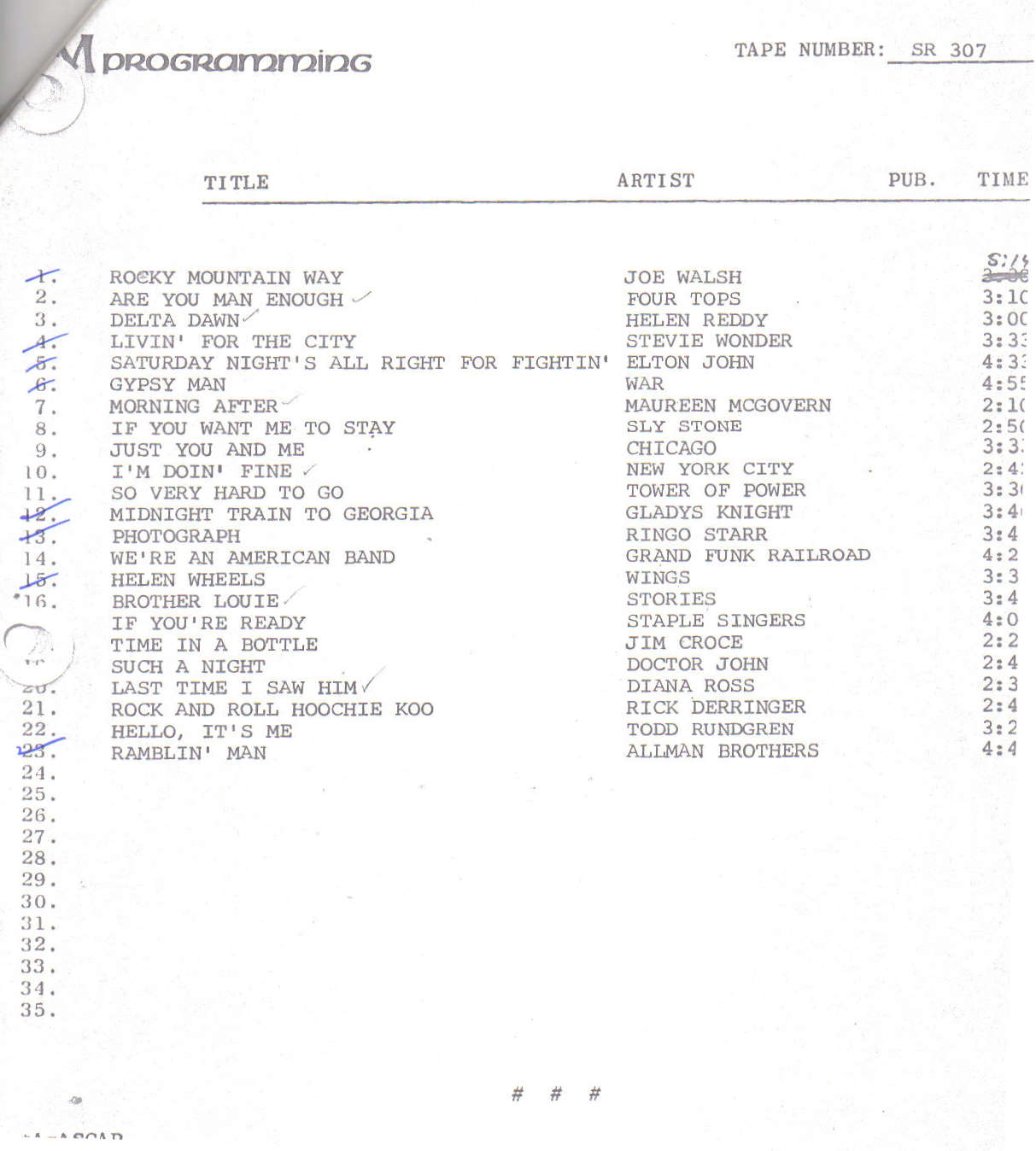
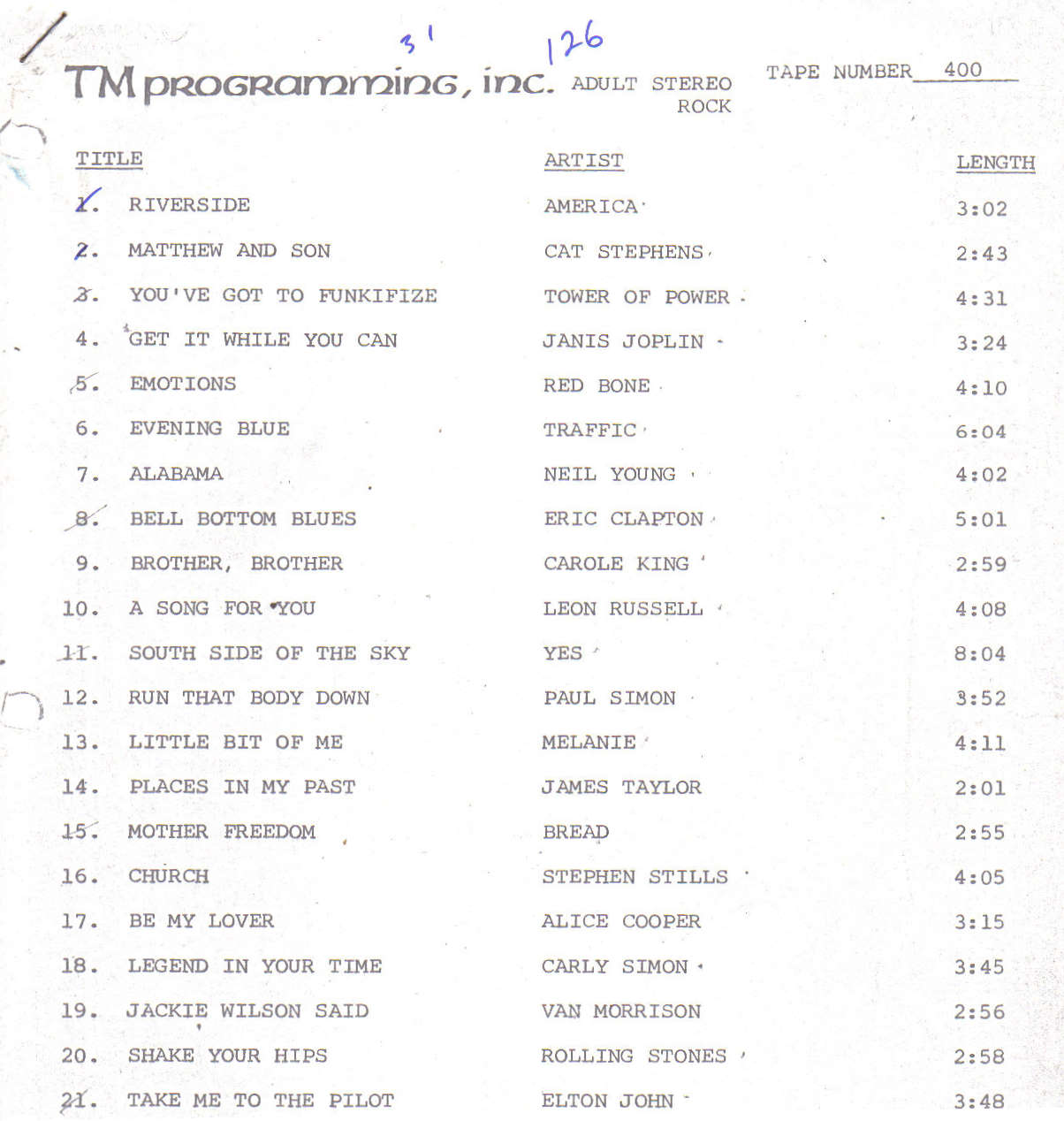
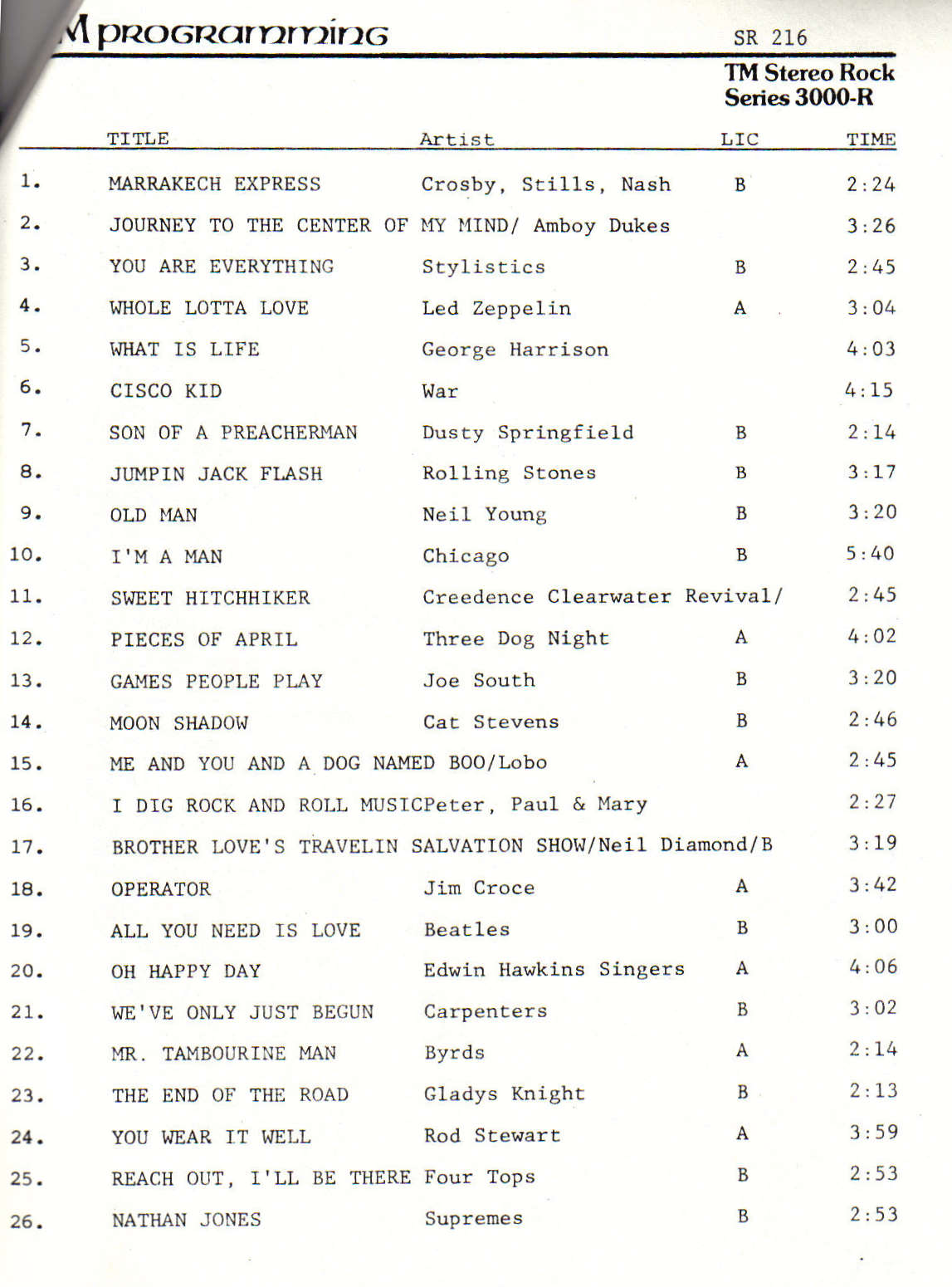
Each quarter hour was the same. The 400s at night were placed between the 200 and 300 categories. The current tapes were updated every two weeks. We had about 10-15 current tapes always in rotation. The recurrents were updated about four times a year. They added a few reels here and there to get the former currents back on the air in recurrent form. The oldies were updated about two times a year. Again, a few of the former recurrents would show up in the oldies reels eventually. The old tapes were requested to be sent back to Dallas so they could reuse the metal reels, although a mountain of them would pile up before they were ever shipped back!
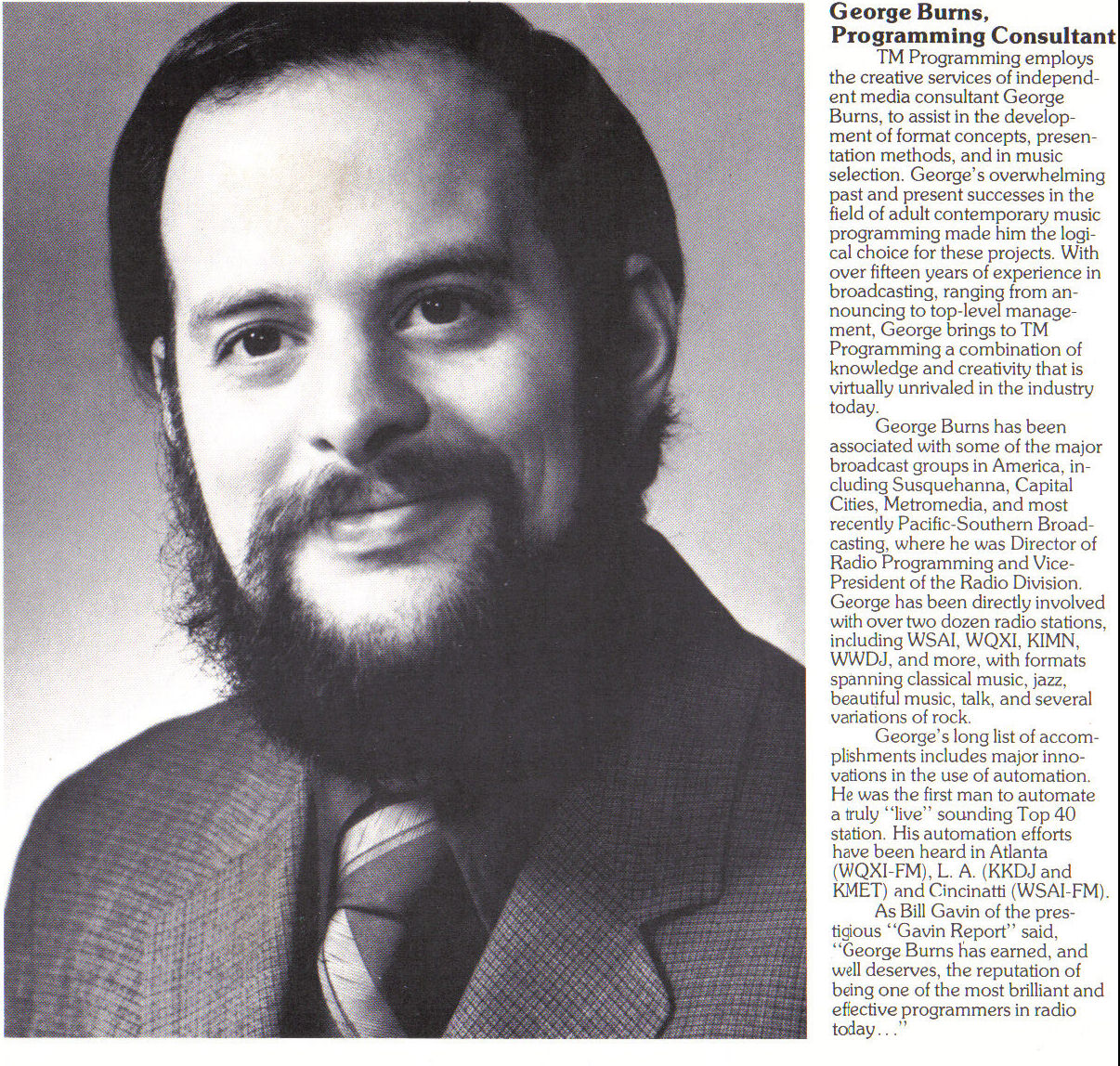
TM's Stereo Rock was consulted by George Burns Media out of Los Angeles.
George would make a market visit about every six months. We would discuss
the overall sound and direction of the station. Although we subscribed to
TM's syndicated format, George would listen to local input and allow us to
take certain songs out of the library while placing some songs in locally.
This gave us some slightly regional sound to the station. It also gave us
the freedom to remove "Beach Baby" that played over and over in the middle
of winter. (I don't hate too many songs, but that one is high on my "kill"
list!) The playlists, reel rotation, music updates, etc., were all
furnished by TM under the direction of George Burns. 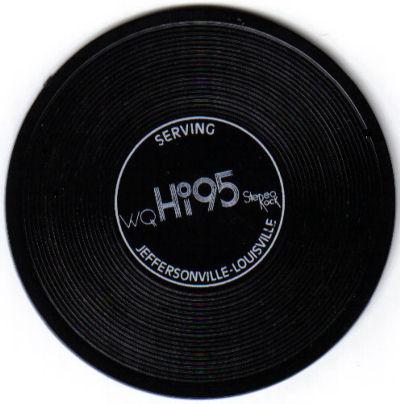 WQHI Promotional Coaster, complete with record-like grooves A few questions I have had over the years:
Here's a personal secret: My
favorite radio station in Louisville was WAKY. The first time I ever
traveled to Louisville working on the HI-95 project, I tuned in WAKY and
heard Bill Bailey. I was in absolute awe of the station. The folks there
knew how to do radio and do it right! When did WQHI become WQMF? Former WQHI staffer Alan White writes: "'QHI stayed intact through
the end of 1980...just after John Lennon's murder. We did an all-night
call-in tribute that night...seriously broke the TM format. "I went to WINN 1240 for a while. It was tough. Many paychecks bounced. I eventually went back to work for my uncle in the electrical business. Then in 1984 I went to WKJJ (later WDJX) and worked part-time...then fulltime for about two years. I jumped over to WAKY in March, 1986. I worked the overnight, then became production director. I left WAKY in March, 1987 and went to the Kentucky News Network. I stayed at KNN for nearly 13 years, until Jacor merged with Clear Channel. The heads rolled. Mine was one. In April 2000, I joined the Salem Radio Group. I stayed just over four years...until I fizzled-out one day...and walked away. Christian Radio is brutal. "After that, I went to Metro Networks for about a year. Split-shift traffic reports. UGH! Metro moved me into news. During my stay at Metro, I got my foot in the door at Cox-Louisville as a part-time board-op. I also earned my Master Electrician license from the state of Kentucky. I got the electrical license as a hedge against the turbulence of radio. (I'm keeping that damned license forever!) "In late Summer of '05, Cox brought me on fulltime as continuity manager. I have since taken on the additional duties of traffic manager for WRKA and WPTI (New Country). Cox is the GREATEST place I've ever worked! I love it...and plan to stay for the rest of my life." |
|

|
|
| WQHI Sales Kit | |
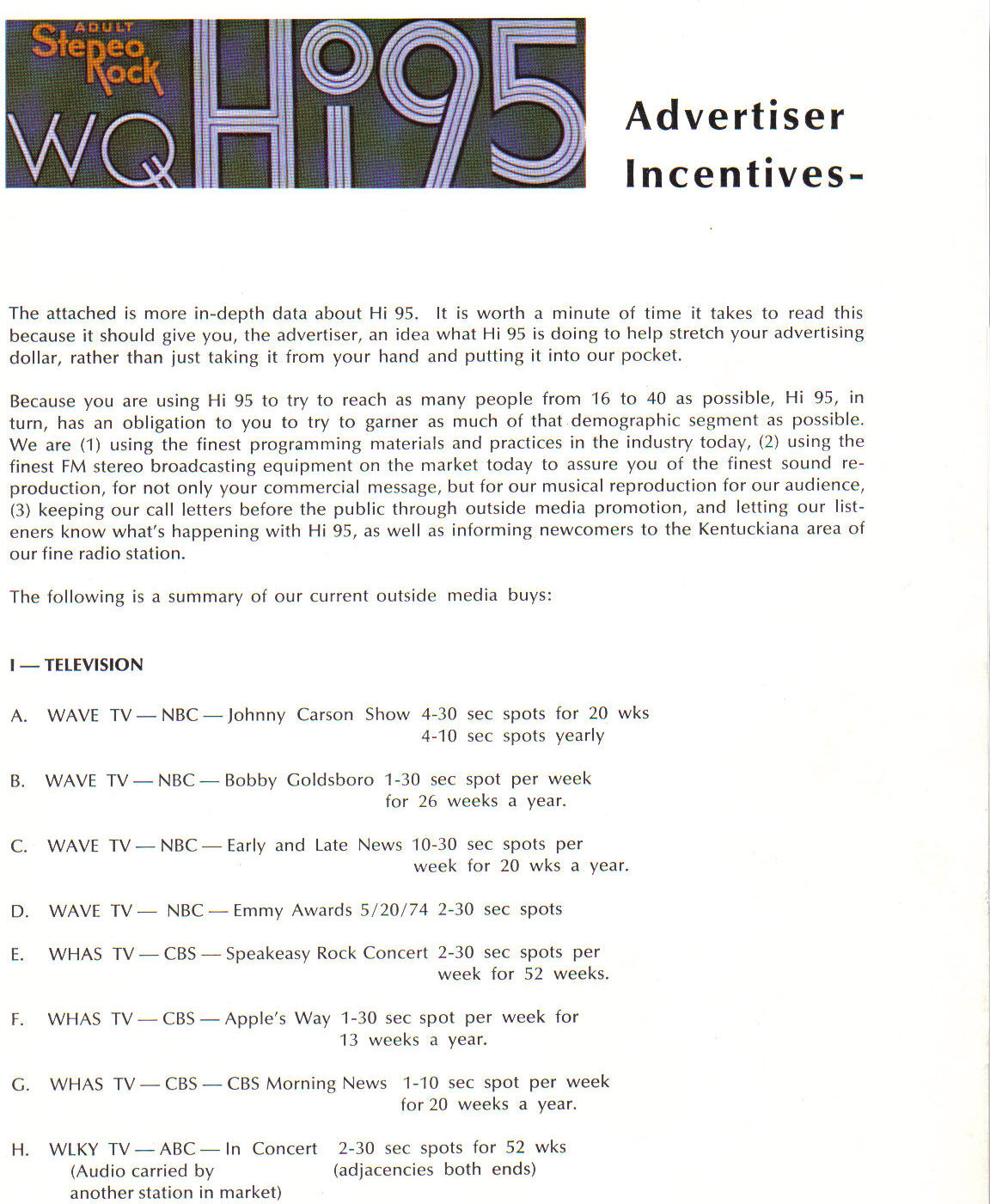
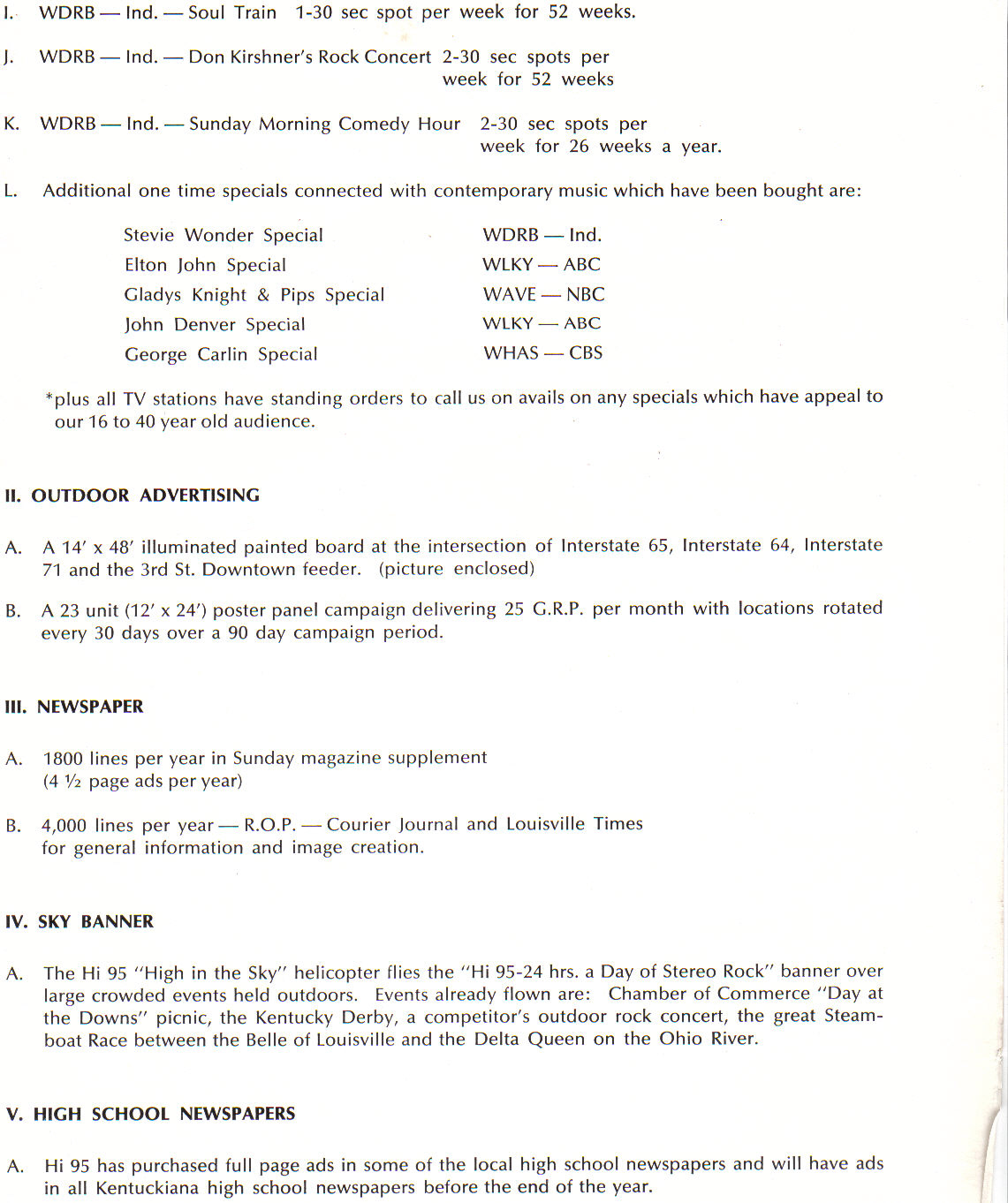
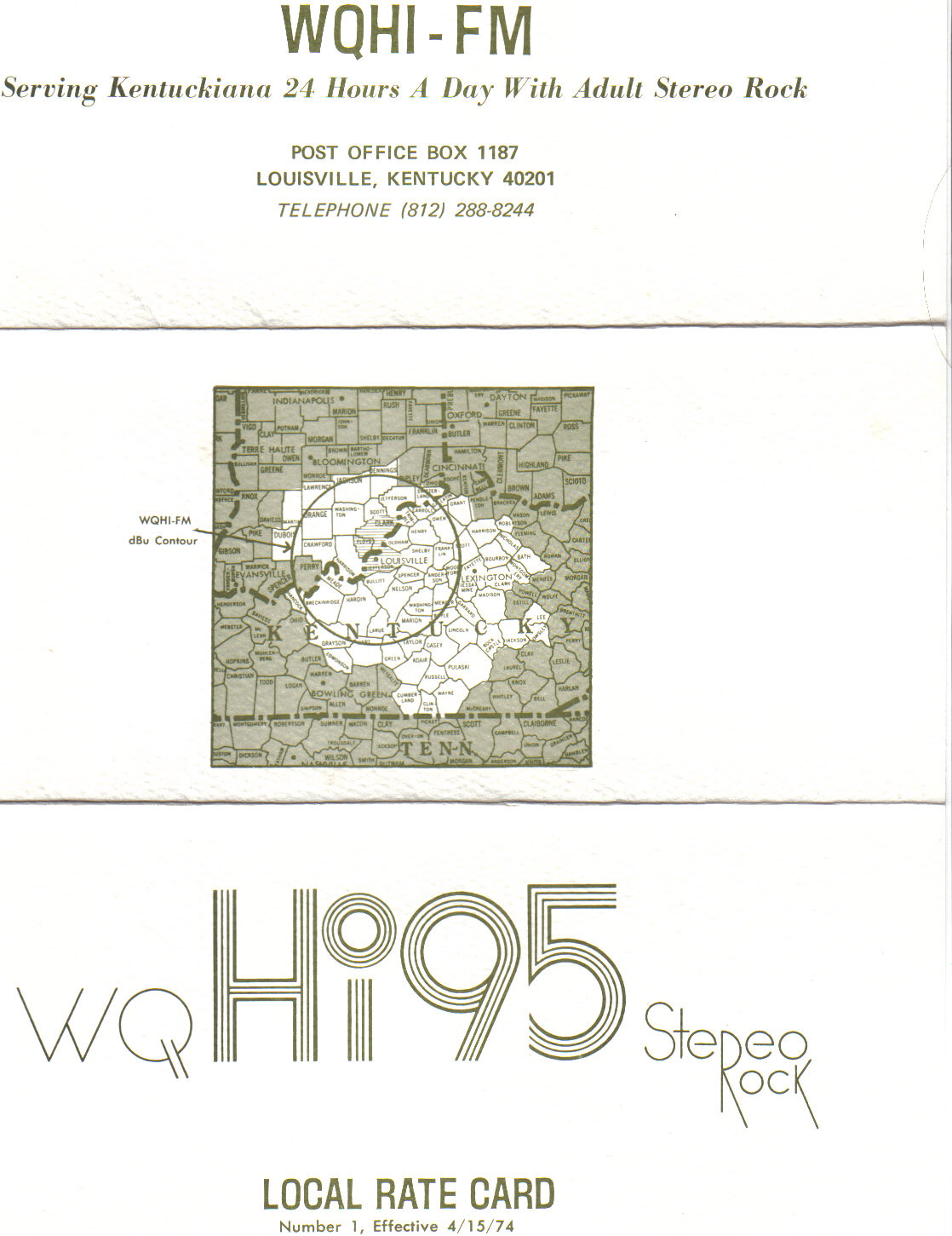
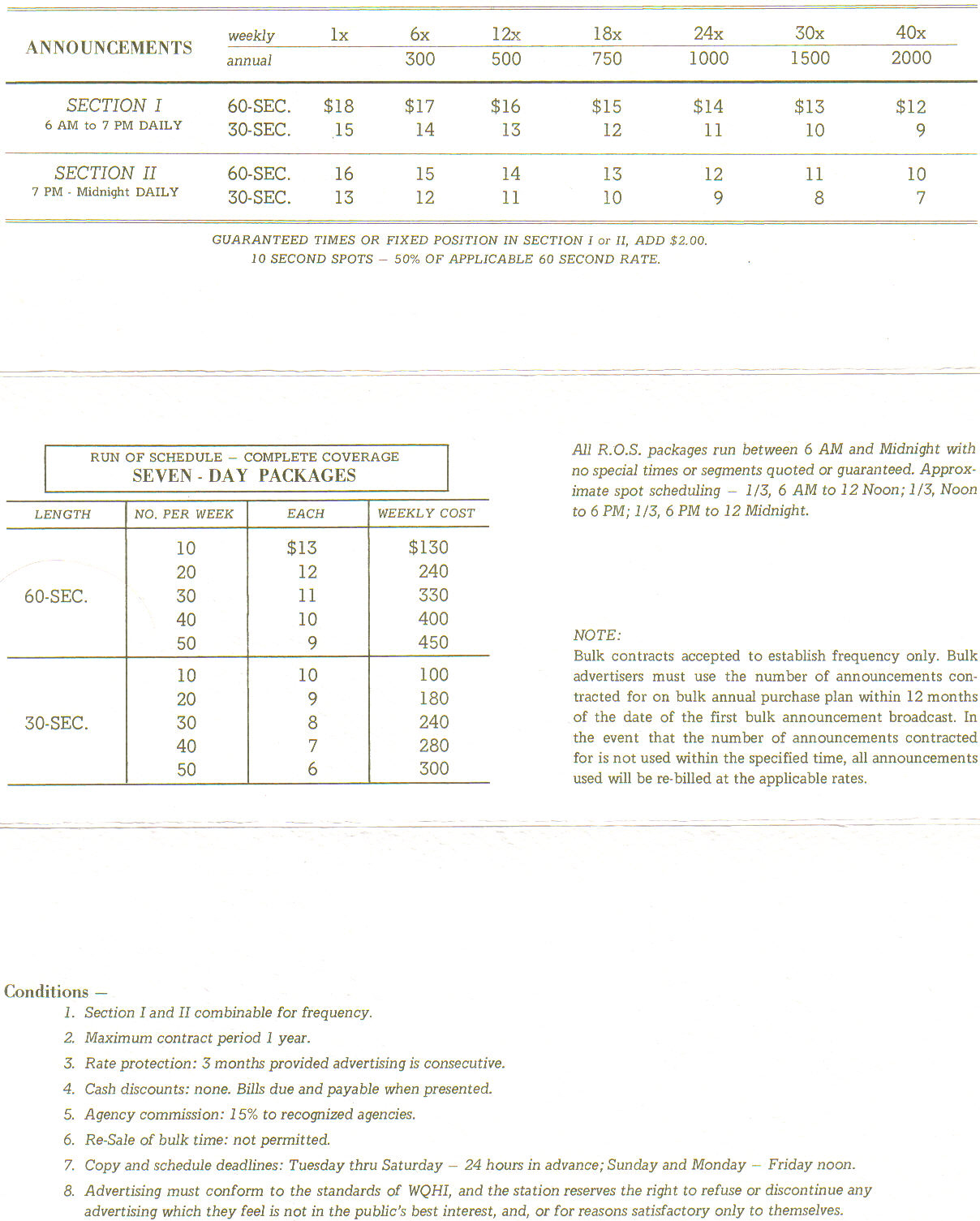
| Thanks to Bill Elliott for sending us scans of the promotional material WQHI passed out to prospective advertisers. You'll see lots of cool photos and station "stuff" of interest to any WQHI fan. | |
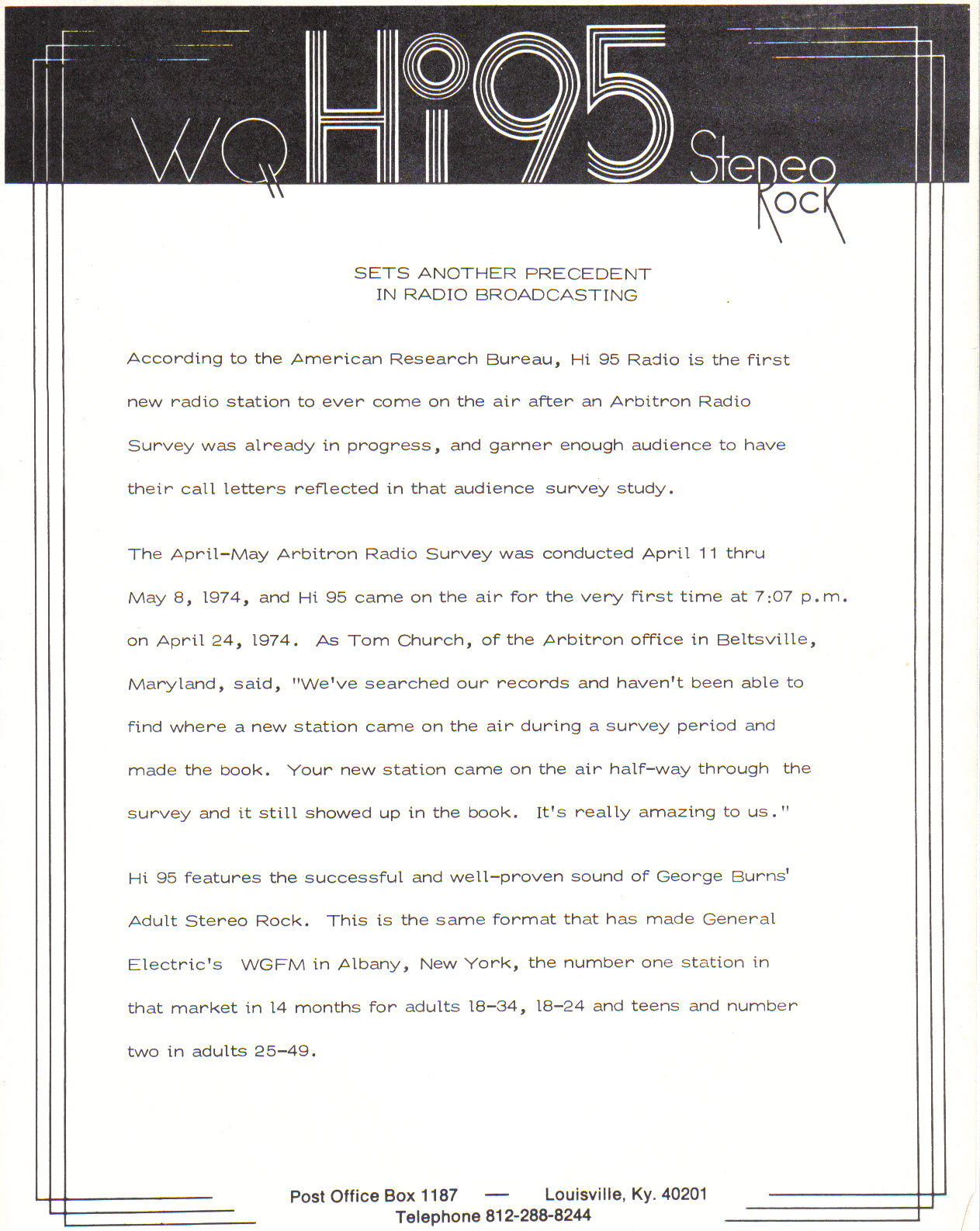
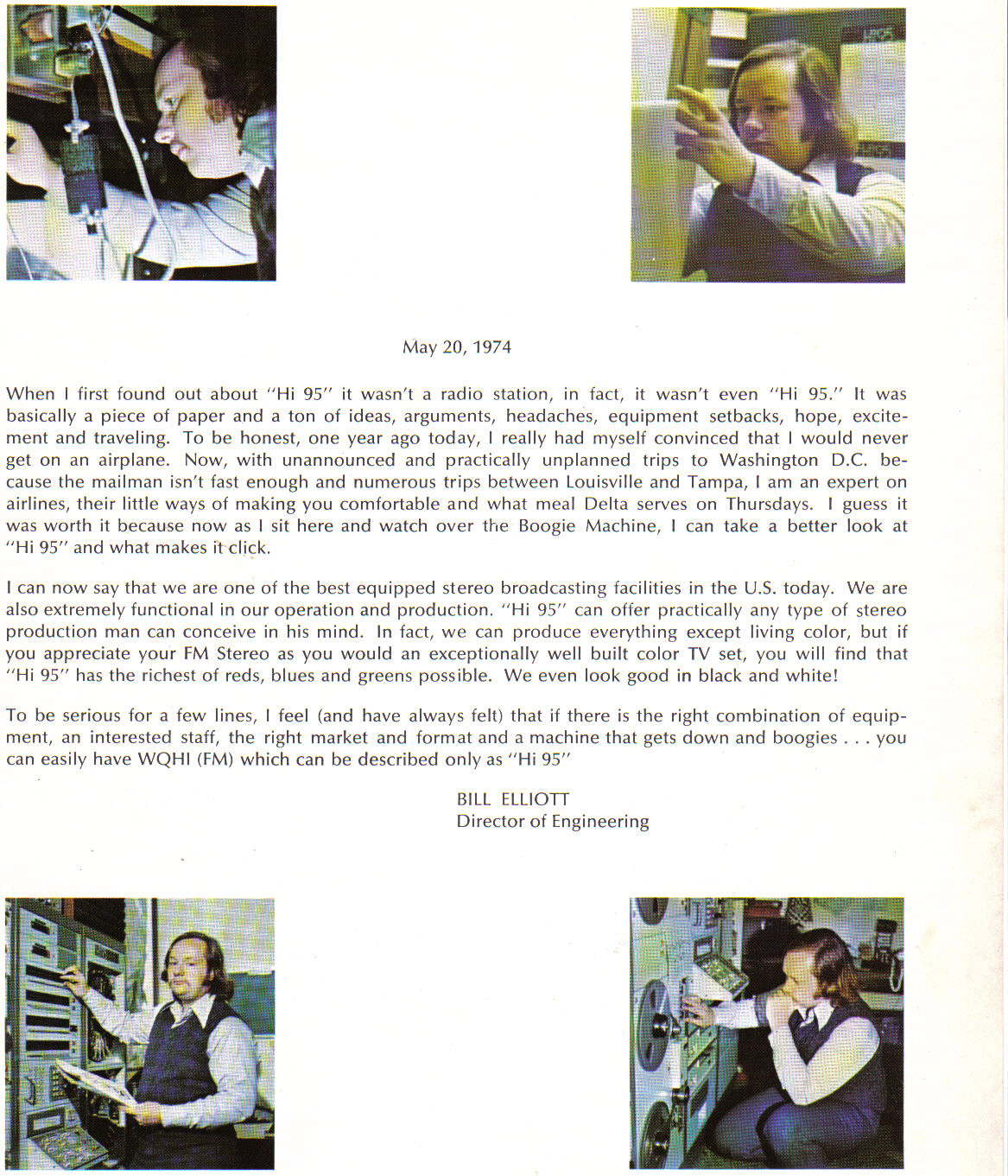
| Arbitron Statement | Bill Elliott Statement |
| Bill and the Automation | Charlie Champion Statement |
| Contour Map | Fact Sheet |
| File Folder | George Burns Bio |
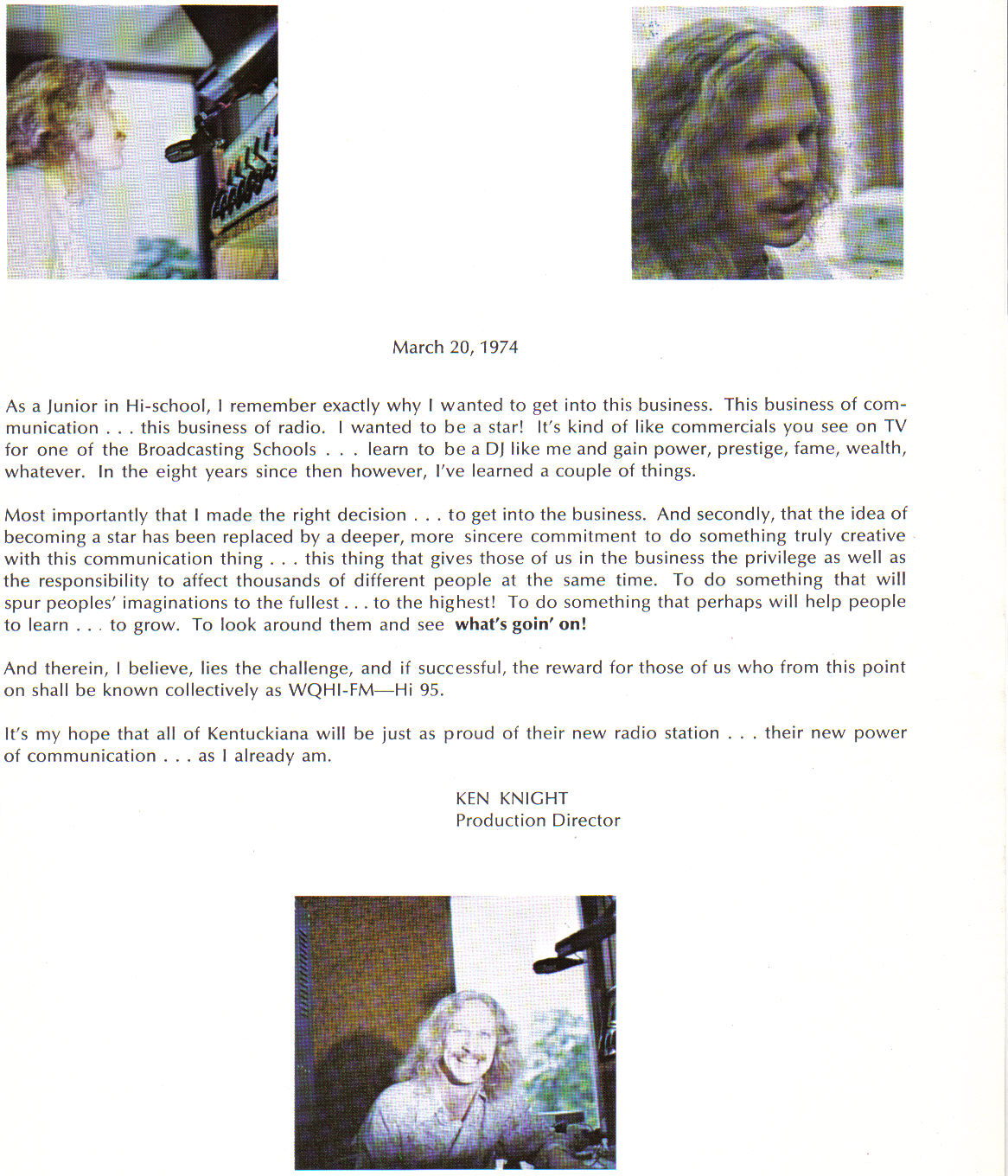
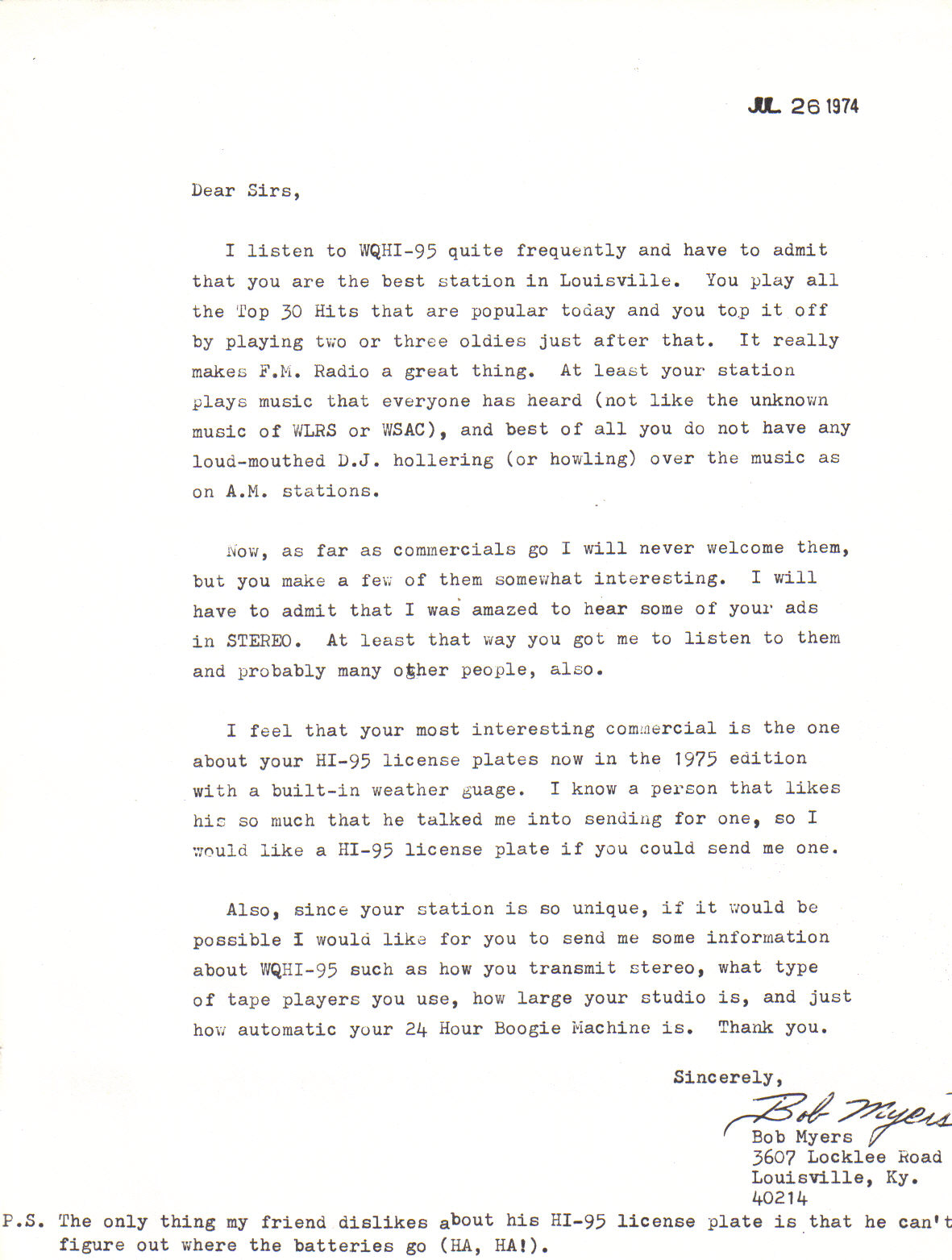
| Ken Knight Statement | Listener Letter |
| Outside Ad Page 1 | Outside Ad Page 2 |
| Rate Card Front | Rate Card Inside |
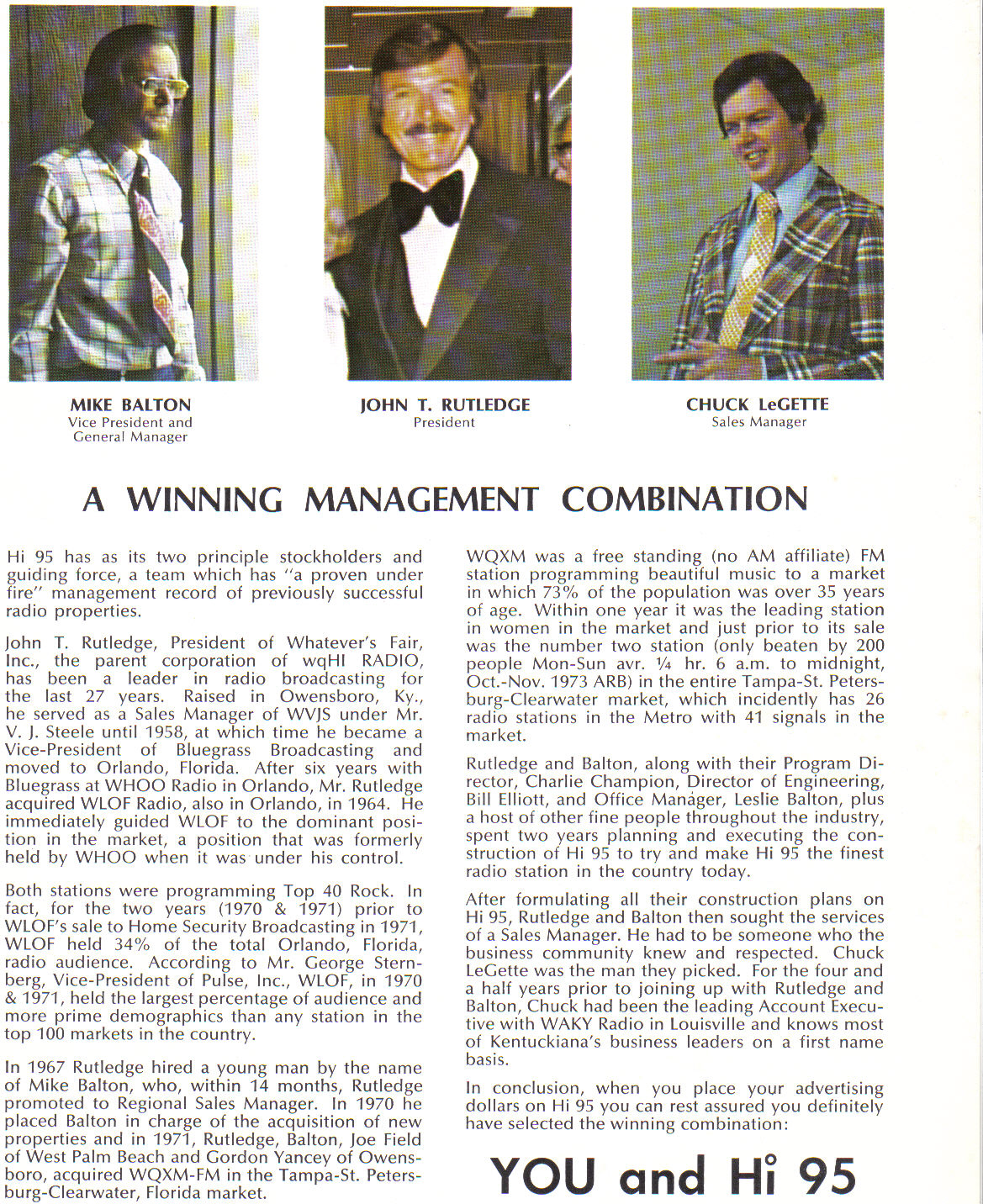
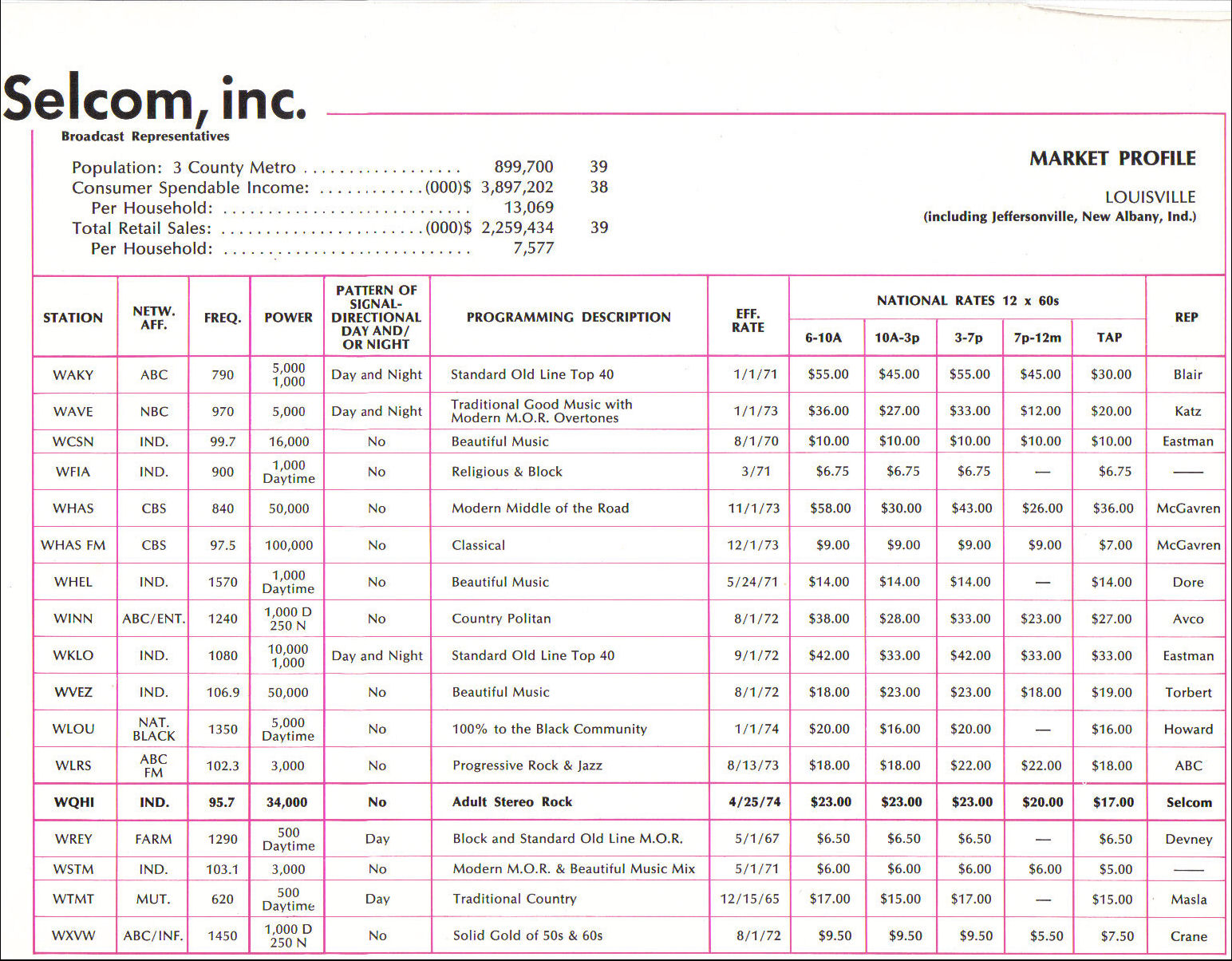
| Management Combination | Selcom Station List |
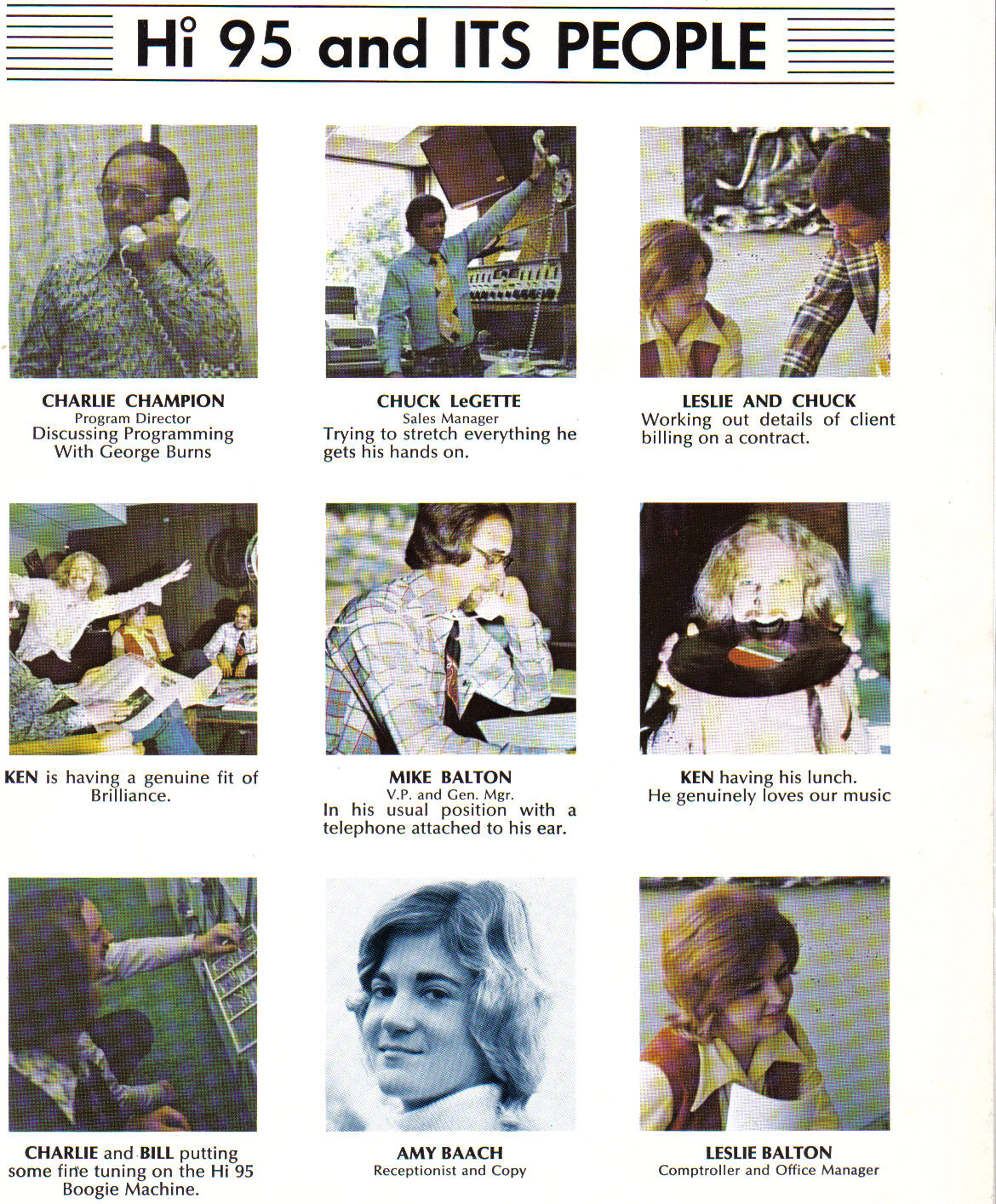
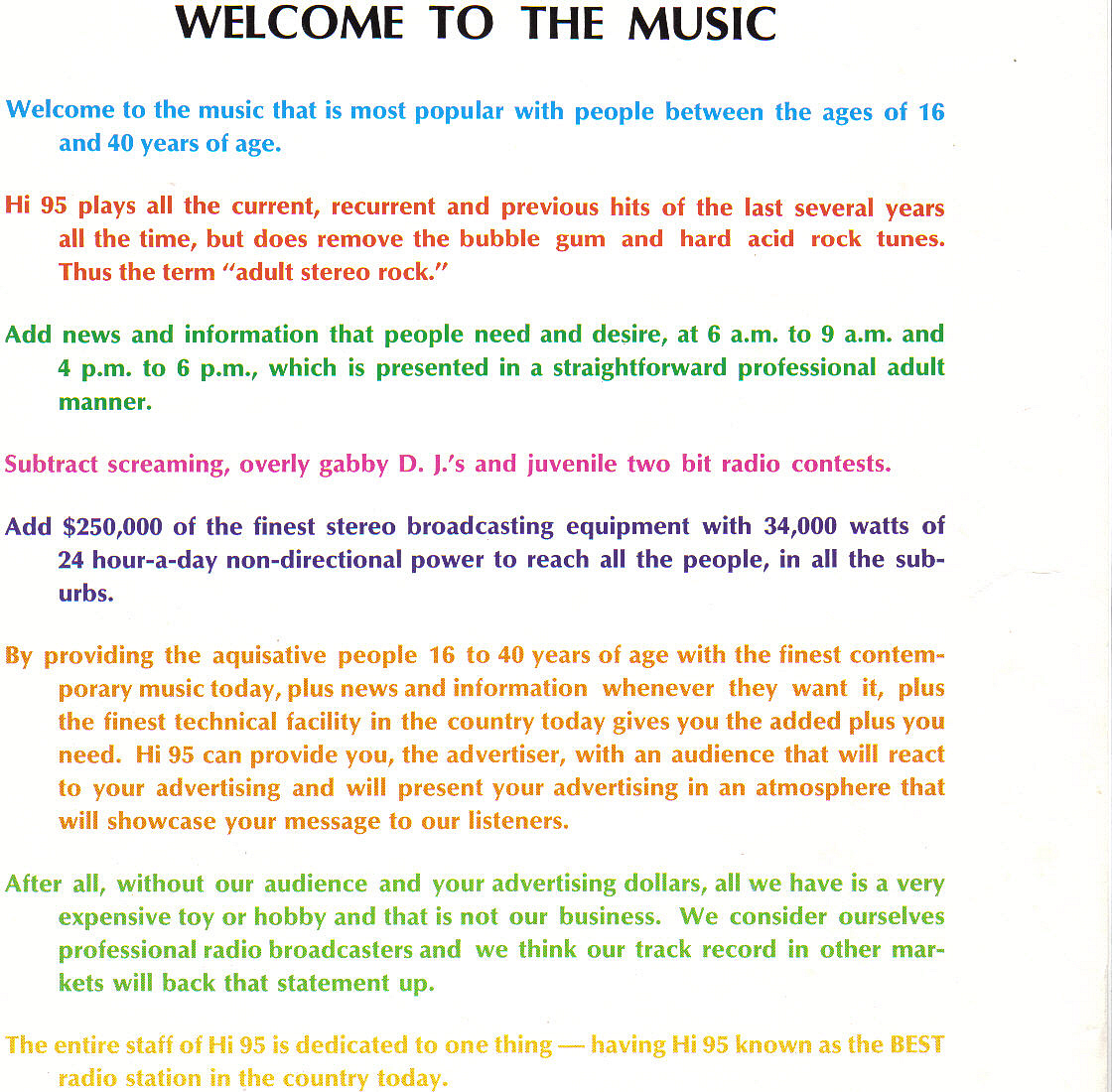
| WQHI Staff | Welcome to the Music |
|
|
|
| WQHI Audio | |
|
WQHI 1974 Dry Liners and Legal IDs :49 - 383 KB |
|
|
WQHI Dry Liners A :38 - 600 KB |
WQHI Dry Liners B :62 - 982 KB |
|
WQHI Produced Liners 2:52 - 2704 KB |
|
|
WQHI 1974 Produced Legal IDs :51 - 404 KB Bill Elliott writes: "A quick note about the music behind the 1974 station legal IDs. The SMC automation we used would not auto log the legal ID when we put it on with dry voice only. We had to add the longer music bed behind the TM announcer to allow time for the Teletype auto logging to print out the time, etc for the legal ID on the hard copy paper log, which you had to have way back when." |
|
|
WQHI 1975 Quad Liners :52 - 413 KB Bill Elliott says: "These image liners went on the air in 1975 after we went 'Quad'. The quad system was a Sansui QS encoder that enhanced the stereo into a matrix (simulated) quad sound. It actually worked quite nicely. I don't know how long they left the quad encoder on line, since the concept of quad died on the vine as quickly as it came out." |
|
|
WQHI Simulated Aircheck #1 17:10 - 12,078 KB This presentation was assembled by WQHI staff who inserted WQHI liners, jingles and spots into an existing TM Stereo Rock demo. It gives you a good idea what WQHI sounded like during its first year. TM later changed the service's "voice" to John Borders, who can be heard on the second simulated aircheck below. |
|
|
WQHI Simulated Aircheck #2 1:02 - 487 KB This simulated WQHI aircheck was part of a TM demo for the Stereo Rock format. It was produced after Dallas announcer John Borders became the official voice of the format. |
|
|
WQHI TV Spot Audio :28 - 165 KB Bill Elliott provides the background on this WQHI TV spot: "We had the video cut somewhere (I think it was through someone TM knew, but not sure). This was well before digital graphics. The spot was a totally black background on the screen with 'floating' WQHI 95 letters moving up, down and all around the screen. We placed the electronic noises on the audio while the letters floated around. They then all lined themselves up and froze into place when the HI95 jingle hit. It was actually pretty cool how they floated the letters around and made them line themselves up on cue. How did they do it? The studio was totally blacked out with people dressed in blacked-out costumes holding the letters, which were painted in day-glow colors. I think they did use black light in the studio, but I can't remember. They started the spot out by dancing around and waving the letters up, down and all around. On cue, they lined all the letters up and they held them still until the end of the spot. It was a great video effect for the day!" |
|
|
WQHI TV Spot Audio - Revised :29 - 230 KB Bill Elliott says: "The revised TV spot is the audio that was changed for the 'floating letter' TV spot when we introduced quad on the station. The voice is Les Cook, who went by the name of Jonathon Stone while at WQHI. We added 'Stone' to his name when he came over from WLRS and was using just one name on the air (Jonathon)." |
|
|
WQHI Richie Havens Liner :05 - 45 KB |
|
|
|
|
| WQHI Jingles | |
|
WQHI 1974 TM
Jingles :40 - 629 KB |
WQHI 1975 TM
Jingles :47 - 745 KB |
|
WQHI 1976 TM
Jingles 4:33 - 5920 KB |
WQHI 1977 TM
Jingles 3:02 - 3817 KB |
|
WQHI 1978 TM
Jingles 1:14 - 1571 KB |
WQHI 1979 TM
Jingles 2:47 - 3894 KB |
|
WQHI 1980 TM
Jingles 4:07 - 5740 KB |
WQHI Undated TM
Jingles 1:52 - 1767 KB |
|
WQHI TM
Liner/Jingle Hybrids A 1:51 - 1748 KB |
WQHI TM
Liner/Jingle Hybrids B 2:23 - 2248 KB |
| For more information on TM jingles, go to the TM Studios Website. | |
| All audio is in downloadable MP3 format. | |
Home Page | Louisville Radio | Lexington Radio | Message Board | Contact Us